Sunday, August 20, 2023

Currency Strength Revisited

Currency Strength Revisited

Recently I responded to a Quantitative Finance forum question here, where I invited the questioner to peruse certain posts on this blog. Apparently the posts do not provide enough information to fully answer the question (my bad) and therefore this post provides what I think will suffice as a full and complete reply, although perhaps not scientifically rigorous.

The original question asked was "Is it possible to separate or decouple the two currencies in a trading pair?" and I believe what I have previously described as a "currency strength indicator" does precisely this (blog search term ---> https://dekalogblog.blogspot.com/search?q=currency+strength+indicator). This post outlines the rationale behind my approach.

Take, for example, the GBPUSD forex pair, and further give it a current (imaginary) value of 1.2500. What does this mean? Of course it means 1 GBP will currently buy you 1.25 USD, or alternatively 1 USD will buy you 1/1.25 = 0.8 GBP. Now rather than write GBPUSD let's express GBPUSD as a ratio thus:- GBP/USD, which expresses the idea of "how many USD are there in a GBP?" in the same way that 9/3 shows how many 3s there are in 9. Now let's imagine at some time period later there is a new pair value, a lower case "gbp/usd" where we can write the relationship

                    (1)     ( GBP / USD ) * ( G / U ) = gbp / usd

to show the change over the time period in question. The ( G / U ) term is a multiplicative term to show the change in value from old GBP/USD 1.2500 to say new value gbp/usd of 1.2600, 

e.g.                ( G / U ) == ( gbp / usd ) / ( GBP / USD ) == 1.26 / 1.25 == 1.008

from which it is clear that the forex pair has increased by 0.8% in value over this time period. Now, if we imagine that over this time period the underlying, real value of USD has remained unchanged this is equivalent to setting the value U in ( G / U ) to exactly 1, thereby implying that the 0.8% increase in the forex pair value is entirely attributable to a 0.8% increase in the underlying, real value of GBP, i.e. G == 1.008. Alternatively, we can assume that the value of GBP remains unchanged,

 e.g.                G == 1, which means that U == 1 / 1.008 == 0.9921

which implies that a ( 1 - 0.9921 ) == 0.79% decrease in USD value is responsible for the 0.8% increase in the pair quote.

Of course, given only equation (1) it is impossible to solve for G and U as either can be arbitrarily set to any number greater than zero and then be compensated for by setting the other number such that the constant ( G / U ) will match the required constant to account for the change in the pair value.

However, now let's introduce two other forex pairs (2) and (3) and thus we have:-

                    (1)     ( GBP / USD ) * ( G / U ) = gbp / usd

                    (2)     ( EUR / USD ) * ( E / U ) = eur / usd

                    (3)     ( EUR / GBP ) * ( E / G ) = eur / gbp

We now have three equations and three unknowns, namely G, E and U, and so this system of equations could be laboriously, mathematically solved by substitution. 

However, in my currency strength indicator I have taken a different approach. Instead of solving mathematically I have written an error function which takes as arguments a list of G, E, U, ... etc. for all currency multipliers relevant to all the forex quotes I have access to, approximately 47 various crosses which themselves are inputs to the error function, and this function is supplied to Octave's fminunc function to simultaneously solve for all G, E, U, ... etc. given all forex market quotes. The initial starting values for all G, E, U, ... etc. are 1, implying no change in values across the market. These starting values consistently converge to the same final values for G, E, U, ... etc for each separate period's optimisation iterations.

Having got all G, E, U, ... etc. what can be done? Well, taking G for example, we can write

                    (4)     GBP * G = gbp

for the underlying, real change in the value of GBP. Dividing each side of (4) by GBP and taking logs we get

                    (5)     log( G ) = log( gbp / GBP )

i.e. the log of the fminunc returned value for the multiplicative constant G is the equivalent of the log return of GBP independent of all other currencies, or as the original forum question asked, the (change in) value of GBP separated or decoupled the from the pair in which it is quoted.

Of course, having the individual log returns of separated or decoupled currencies, there are many things that can be done with them, such as:-

  • create indices for each currency
  • apply technical analysis to these separate indices
  • intermarket currency analysis
  • input to machine learning (ML) models
  • possibly create new and unique currency indicators

Examples of the creation of "alternative price charts" and indices are shown below

where the black line is the actual 10 minute closing prices of GBPUSD over the
last week (13th to 18th August) with the corresponding GBP price (blue line) being the "alternative" GBPUSD chart if U is held at 1 in the ( G / U ) term and G allowed to be its derived, optimised value, and the USD price (red line) being the alternative chart if G is held at 1 and U allowed to be its derived, optimised value.

This second chart shows a more "traditional" index like chart

where the starting values are 1 and both the G and U values take their derived values. As can be seen, over the week there was upwards momentum in both the GBP and USD, with the greater momentum being in the GBP resulting in a higher GBPUSD quote at the end of the week. If, in the second chart the blue GBP line had been flat at a value of 1 all week, the upwards momentum in USD would have resulted in a lower week ending quoted value of GBPUSD, as seen in the red USD line in the first chart. Having access to these real, decoupled returns allows one to see through the given, quoted forex prices in the manner of viewing the market as though through X-ray vision. 

I hope readers find this post enlightening, and if you find some other uses for this idea, I would be interested in hearing how you use it.
 

Tuesday, May 30, 2023

Friday, March 3, 2023

Applying Corrective AI to Daily Seasonal Forex Trading

Applying Corrective AI to Daily Seasonal Forex Trading


By
Sergei Belov, Ernest
Chan, Nahid Jetha, and
Akshay Nautiyal


ABSTRACT


We applied
Corrective
AI (Chan, 2022) to a trading model that takes
advantage of the intraday seasonality of forex returns. Breedon and Ranaldo
(2012)  observed that foreign currencies
depreciate vs. the US dollar during their local working hours and appreciate
during the local working hours of the US dollar. We first backtested the
results of Breedon and Ranaldo on recent EURUSD data from September 2021 to
January 2023 and then applied Corrective AI to this trading strategy to achieve
a significant increase in performance.


Breedon and Ranaldo (2012) described a trading strategy that shorted EURUSD during European working hours (3 AM ET to 9 AM ET,where ET denotes the local time in New York, accounting for daylight savings) and bought EURUSD during US working hours (11 AM ET to 3 PM ET). The rationale is that large-scale institutional buying of the US dollar takes place during European working hours to pay global invoices and the reverse happens during US working hours. Hence this effect is also called the “invoice effect".

There is some supportive evidence for the time-of-the-day patterns in various measures of the forex market like volatility (see Baille and Bollerslev(1991), or Andersen and Bollerslev(1998)), turnover (see Hartman (1999), or Ito and Hashimoto(2006)), and return (see Cornett(1995), or Ranaldo(2009)).  Essentially,local currencies depreciate during their local working hours for each of these measures and appreciate during the working hours of the United States.

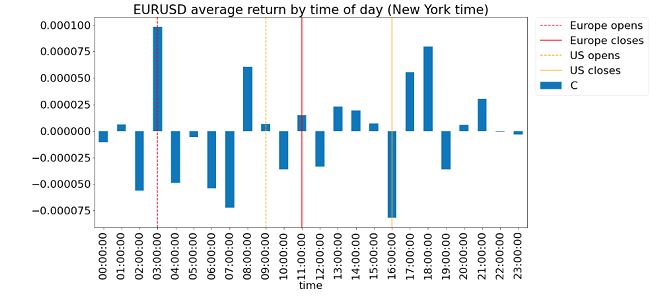
Figure 1 below describes the average hourly return of each hour in the day over a period starting from 2019-10-01 17:00 ET to 2021-09-01 16:00 ET. It reveals the pattern of returns in EURUSD. The return
pattern in the above-described “working hours'' reconciles with the hypothesis of a prevalent “invoice effect” broadly. Returns go down during European working and up during US working hours.

Figure
1: Average EURSUD return by time of day (New York time)

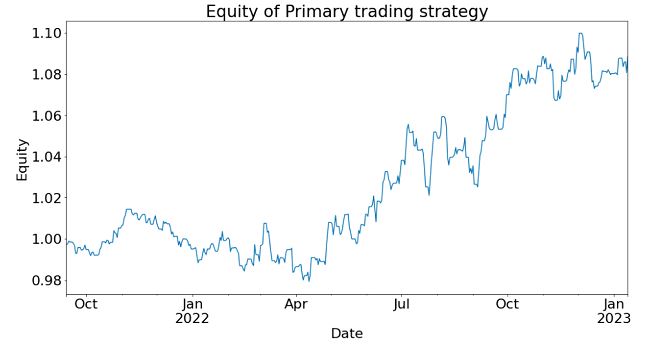
As this strategy was published in 2012, it offers ample time for true out-of-sample testing. We collected 1-minute bar data of EURUSD from Electronic Broking Services (EBS) and performed a backtest over the out-of-sample period October 2021-January 2023. The Sharpe Ratio of the strategy in this period is  0.88, with average annual returns of 3.5% and a maximum drawdown of -3.5%. The alpha of the strategy apparently endured. (For the purpose of this article, no transaction costs are included in the backtest because our only objective is to compare the performances with and without Corrective AI, not to determine if this trading strategy is viable in live production.)

Figure 2 below shows the equity curve (“growth of $1”) of the strategy during the aforementioned out-of-sample period. The cumulative returns during this period are just below 8%. We call this the “Primary” trading strategy, for reasons that will become clear below.

Figure

2: Equity curve of Primary trading strategy in out-of-sample period


What is Corrective AI?

Suppose
we have a trading model (like the Primary trading strategy described above) for setting the side of the bet (long or short). We just need to learn the size of that bet, which includes the possibility of no bet at all (zero sizes). This is a situation that practitioners face regularly. A machine learning algorithm (ML) can be trained to determine that. To emphasize, we do not want the ML algorithm to learn or predict the side, just to tell us what is the appropriate size.

We call this problem meta-labeling (Lopez de Prado, 2018) or Corrective AI (Chan, 2022) because we want to build a secondary ML model that learns how to use a primary trading model.

We train an ML algorithm to compute the “Probability of Profit” (PoP) for the next minute-bar. If the PoP is greater than 0.5, we will set the bet size to 1; otherwise we will set it to 0. In other words, we adopt the step function as the bet sizing function that takes PoP as an input and gives the bet size as an
output, with the threshold set at 0.5.  This bet sizing function decides whether to take the bet or pass, a
purely binary prediction.

The training period was from 2019-01-01 to 2021-09-30 while the out-of-sample test period was from 2021-10-01 to 2023-01-15, consistent with the out-of-sample period we reported for the Primary trading strategy. The model used to train ML algorithm was done using the predictnow.ai Corrective AI (CAI) API, with more than a hundred pre-engineered input features (predictors). The underlying learning algorithm is a gradient-boosting decision tree.

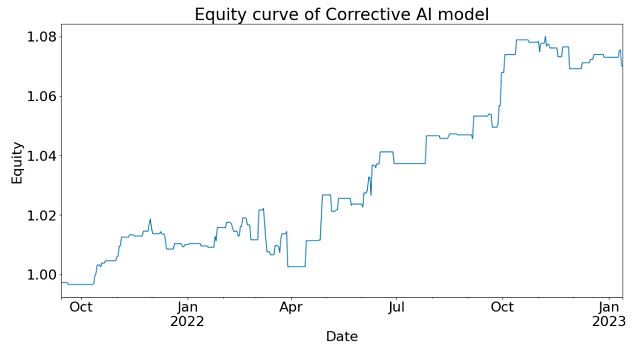
After applying Corrective AI, the Sharpe Ratio of the strategy in this period is 1.29  (an increase of 0.41), with average annual returns of 4.1% (an increase of 0.6%)  and a maximum drawdown of -1.9%
(a decrease of 1.6%). The alpha of the strategy is significantly improved.

The equity curve of the Corrective AI filtered secondary model signal can be seen in the figure below.

Figure
3: Equity curve of Corrective AI model  in out-of-sample period


Features used to train the Corrective AI model include technical indicators generated from indices, equities, futures, and options markets. Many of these features were created using Algoseek’s high-frequency futures and equities data. More discussions of these features can be found in (Nautiyal & Chan, 2021).

Conclusion:

By applying Corrective AI to the time-of-the-day Primary strategy, we were able to improve the Sharpe ratio and reduce drawdown during the out-of-sample backtest period. This aligns with observations made in the literature on meta-labeling for our primary strategies. The Corrective AI model's signal filtering capabilities do enhance performance in specific scenarios.

Acknowledgment

We are grateful to Chris Bartlett of Algoseek, who generously provided much of the high-frequency data for our feature engineering in our Corrective AI system. We also thank Pavan Dutt for his assistance with feature engineering and to Jai Sukumar for helping us use the Predictnow.ai CAI API. Finally, we express our appreciation to Erik MacDonald and Jessica Watson for their contributions in explaining this technology to Predictnow.ai’s clients

References

Breedon,
F., & Ranaldo, A. (2012, April 3). Intraday
Patterns in FX Returns and Order Flow
. https://ssrn.com/abstract=2099321

Chan,
E. (2022, June 9). What is Corrective AI?
PredictNow.ai. Retrieved February 23, 2023, from
https://predictnow.ai/what-is-corrective-ai/

Lopez
de Prado, M. (2018). Advances in
Financial Machine Learning
. Wiley.

Nautiyal,
A., & Chan, E. (2021). New Additions
to the PredictNow.ai Factor Zoo
. PredictNow.ai. Retrieved February 28,
2023, from https://predictnow.ai/new-additions-to-the-predictnow-ai-factor-zoo/