Showing posts with label Oanda. Show all posts

Wednesday, November 22, 2023

Update to PositionBook Chart - Revised Optimisation Method

Update to PositionBook Chart - Revised Optimisation Method

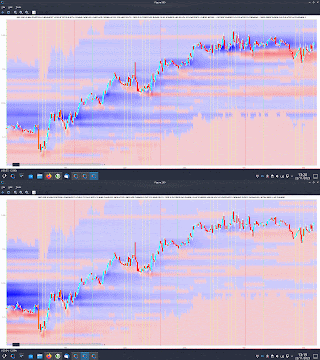
Just over a year ago I previewed a new chart type which I called a "PositionBook Chart" and gave examples in this post and this one. These first examples were based on an optimisation routine over 6 variables using Octave's fminunc function, an unconstrained minimisation routine. However, I was not 100% convinced that the model I was using for the loss/cost function was realistic, and so since the above posts I have been further testing different models to see if I could come up with a more satisfactory model and optimisation routine. The comparison between the original model and the better, newer model I have selected is indicated in the following animated GIF, which shows the last few day's action in the GBPUSD forex pair. 

The old model is figure(200), with the darker blue "blob" of positions accumulated at the lower, beginning of the chart, and the newer model, figure(900), shows accumulation throughout the uptrend. The reasons I prefer this newer model are:

  • 4 of the 6 variables mentioned above (longs above and below price bar range, and shorts above and below price bar range) are theoretically linked to each other to preserve their mutual relationships and jointly minimised over a single input to the loss/cost function, which has a bounded upper and lower limit. This means I can use Octave's fminbnd function instead of fminunc. The minimisation objective is the minimum absolute change in positions outside the price bar range, which has a real world relevance as compared to the mean squared error of the fminunc cost function.
  • because fminunc is "unconstrained" occasionally it would converge to unrealistic solutions with respect to position changes outside the price bar range. This does not happen with the new routine.
  • once the results of fminbnd are obtained, it is possible to mathematically calculate the position changes within the price bar range exactly, without needing to resort to any optimisation routine. This gives a zero error for the change which is arguably the most important.
  • the results from the new routine seem to be more stable in that indicators I am trying to create from them are noticeably less erratic and confusing than those created from fminunc results.
  • finally, fminbnd over 1 variable is much quicker to converge than fminunc over 6 variables.
The second last mentioned point, derived indicators, will be the subject of my next post.

Friday, November 18, 2022

PositionBook Chart Example Trade

PositionBook Chart Example Trade

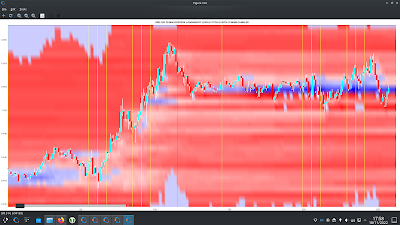
As a quick follow up to my previous post I thought I'd show an example of how one could possibly use my new PositionBook chart as a trade set-up. Below is the USD_CHF forex pair for the last two days

showing the nice run-up yesterday and then the narrow range of Friday's Asian session.

The tentative set-up idea is to look for such a narrow range and use the colour of the PositionBook chart in this range (blue for a long) to catch or anticipate a breakout. The take profit target would be the resistance suggested by the horizontal yellow bar in the open orders chart (overhead sell orders) more or less at Thursday's high.

I decided to take a really small punt on this idea but took a small loss of 0.0046 GBP
as indicated in the above Oanda trade app. I entered too soon and perhaps should have waited for confirmation (I can see a doji bar on the 5 minute chart just after my stop out) or had the conviction to re-enter the trade after this doji bar. The initial trade idea seems to have been sound as the profit target was eventually hit. This could have been a nice 4/5/6 R-multiple profitable trade.😞

Friday, November 11, 2022

A New PositionBook Chart Type

A New PositionBook Chart Type

It has been almost 6 months since I last posted, due to working on a house renovation. However, I have still been thinking about/working on stuff, particularly on analysis of open position ratios. I had tried using this data as features for machine learning, but my thinking has evolved somewhat and I have reduced my ambition/expectation for this type of data.

Before I get into this I'd like to mention Trader Dale (I have no affiliation with him) as I have recently been following his volume profile set-ups, a screenshot of one being shown below.

This shows recent Wednesday action in the EUR_GBP pair on a 30 minute chart. The flexible volume profile set-up Trader Dale describes is called a Volume Accumulation Set-up which occurs immediately prior to a big break (in this case up). The whole premise of this particular set-up is that the volume accumulation area will be future support, off of which price will bounce, as shown by the "hand drawn" lines. Below is shown my version of the above chart
with a bit of extra price action included. The horizontal yellow lines show the support area.

Now here is the same data, but in what I'm calling a PositionBook chart, which uses Oanda's Position Level data downloaded via their API.

The blue (red) horizontal lines show the levels at which traders are net long (short) in terms of positions actually entered/held. The brighter the colours the greater the difference between the longs/shorts. It is obvious that the volume accumulation set-up area is showing a net accumulation of long positions and this is an indication of the direction of the anticipated breakout long before it happens. The Trader Dale set-up presumes an accumulation of longs because of the resultant breakout direction and doesn't seem to provide an opportunity to participate in the breakout itself!

The next chart shows the action of the following day and a bit where the price does indeed come back down to the "support" area but doesn't result in an immediate bounce off the support level. The following order level chart perhaps shows why there was no bounce - the relative absence of open orders at that level.

The equivalent PositionBook chart, including a bit more price action,
shows that after price fails to bounce off the support level it does recover back into it and then even more long positions are accumulated (the darker blue shade) at the support level during the London open, again allowing one to position oneself for the ensuing rise during the London morning session, followed by another long accumulation during the New York opening session for a following leg up into the London close (the last vertical red line).

This purpose of this post is not to criticise the Trader Dale set-up but rather to highlight the potential value-add of these new PositionBook charts. They seem to hold promise for indicating price direction and I intend to continue investigating/improving them in the coming weeks.

More in due course.

Friday, April 8, 2022

Simple Machine Learning Models on OrderBook/PositionBook Features

Simple Machine Learning Models on OrderBook/PositionBook Features

This post is about using OrderBook/PositionBook features as input to simple machine learning models after previous investigation into the relevance of such features. 

Due to the amount of training data available I decided to look only at a linear model and small neural networks (NN) with a single hidden layer with up to 6 hidden neurons. This choice was motivated by an academic paper I read online about linear models which stated that, as a lower bound, one should have at least 10 training examples for each parameter to be estimated. Other online reading about order flow imbalance (OFI) suggested there is a linear relationship between OFI and price movement. Use of limited size NNs would allow a small amount of non linearity in the relationship. For this investigation I used the Netlab toolbox and Octave. A plot of the learning curves of the classification models tested is shown below. The targets were binary 1/0 for price increases/decreases.
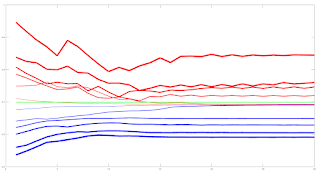
The blue lines show the average training error (y axis) and the red lines show the same average error metric on the held out cross validation data set for each tested model. The thickness of the lines represents the number of neurons in the single hidden layer of the NNs (the thicker the lines, the higher the number of hidden neurons). The horizontal green line shows the error of a generalized linear model (GLM) trained using iteratively reweighted least squares. It can be seen that NN models with 1 and 2 hidden neurons slightly outperform the GLM, with the 2 neuron model having the edge over the 1 neuron model. NN models with 3 or more hidden neurons over fit and underperform the GLM. The NN models were trained using Netlab's functions for Bayesian regularization over the parameters.

Looking at these results it would seem that a 2 neuron NN would be the best choice; however the error differences between the 1 and 2 neuron NNs and GLM are small enough to anticipate that the final classifications (with a basic greater/less than a 0.5 logistic threshold value for long/short) would perhaps be almost identical. 

Investigations into this will be the subject of my next post. 

The code box below gives the working Octave code for the above.

## load data
##training_data = dlmread( 'raw_netlab_training_features' ) ;
##cv_data = dlmread( 'raw_netlab_cv_features' ) ;
training_data = dlmread( 'netlab_training_features_svd' ) ;
cv_data = dlmread( 'netlab_cv_features_svd' ) ;
training_targets = dlmread( 'netlab_training_targets' ) ;
cv_targets = dlmread( 'netlab_cv_targets' ) ;

kk_loop_record = zeros( 30 , 7 ) ;

for kk = 1 : 30

## first train a glm model as a base comparison
input_dim = size( training_data , 2 ) ; ## Number of inputs.

net_lin = glm( input_dim , 1 , 'logistic' ) ; ## Create a generalized linear model structure.
options = foptions ; ## Sets default parameters for optimisation routines, for compatibility with MATLAB's foptions()
options(1) = 1 ; ## change default value
## OPTIONS(1) is set to 1 to display error values during training. If
## OPTIONS(1) is set to 0, then only warning messages are displayed. If
## OPTIONS(1) is -1, then nothing is displayed.
options(14) = 5 ; ## change default value
## OPTIONS(14) is the maximum number of iterations for the IRLS
## algorithm; default 100.
net_lin = glmtrain( net_lin , options , training_data , training_targets ) ;

## test on cv_data
glm_out = glmfwd( net_lin , cv_data ) ;
## cross-entrophy loss
glm_out_loss = -mean( cv_targets .* log( glm_out ) .+ ( 1 .- cv_targets ) .* log( 1 .- glm_out ) ) ;

kk_loop_record( kk , 7 ) = glm_out_loss ;

## now train an mlp
## Set up vector of options for the optimiser.
nouter = 30 ; ## Number of outer loops.
ninner = 2 ; ## Number of innter loops.
options = foptions ; ## Default options vector.
options( 1 ) = 1 ; ## This provides display of error values.
options( 2 ) = 1.0e-5 ; ## Absolute precision for weights.
options( 3 ) = 1.0e-5 ; ## Precision for objective function.
options( 14 ) = 100 ; ## Number of training cycles in inner loop.

training_learning_curve = zeros( nouter , 6 ) ;
cv_learning_curve = zeros( nouter , 6 ) ;

for jj = 1 : 6

## Set up network parameters.
nin = size( training_data , 2 ) ; ## Number of inputs.
nhidden = jj ; ## Number of hidden units.
nout = 1 ; ## Number of outputs.
alpha = 0.01 ; ## Initial prior hyperparameter.
aw1 = 0.01 ;
ab1 = 0.01 ;
aw2 = 0.01 ;
ab2 = 0.01 ;

## Create and initialize network weight vector.
prior = mlpprior(nin , nhidden , nout , aw1 , ab1 , aw2 , ab2 ) ;
net = mlp( nin , nhidden , nout , 'logistic' , prior ) ;

## Train using scaled conjugate gradients, re-estimating alpha and beta.
for ii = 1 : nouter
## train net
net = netopt( net , options , training_data , training_targets , 'scg' ) ;

train_out = mlpfwd( net , training_data ) ;
## get train error
## mse
##training_learning_curve( ii ) = mean( ( training_targets .- train_out ).^2 ) ;

## cross entropy loss
training_learning_curve( ii , jj ) = -mean( training_targets .* log( train_out ) .+ ( 1 .- training_targets ) .* log( 1 .- train_out ) ) ;

cv_out = mlpfwd( net , cv_data ) ;
## get cv error
## mse
##cv_learning_curve( ii ) = mean( ( cv_targets .- cv_out ).^2 ) ;

## cross entropy loss
cv_learning_curve( ii , jj ) = -mean( cv_targets .* log( cv_out ) .+ ( 1 .- cv_targets ) .* log( 1 .- cv_out ) ) ;

## now update hyperparameters based on evidence
[ net , gamma ] = evidence( net , training_data , training_targets , ninner ) ;

## fprintf( 1 , '\nRe-estimation cycle ##d:\n' , ii ) ;
## disp( [ ' alpha = ' , num2str( net.alpha' ) ] ) ;
## fprintf( 1 , ' gamma = %8.5f\n\n' , gamma ) ;
## disp(' ')
## disp('Press any key to continue.')
##pause;
endfor ## ii loop

endfor ## jj loop

kk_loop_record( kk , 1 : 6 ) = cv_learning_curve( end , : ) ;

endfor ## kk loop

plot( training_learning_curve(:,1) , 'b' , 'linewidth' , 1 , cv_learning_curve(:,1) , 'r' , 'linewidth' , 1 , ...
training_learning_curve(:,2) , 'b' , 'linewidth' , 2 , cv_learning_curve(:,2) , 'r' , 'linewidth' , 2 , ...
training_learning_curve(:,3) , 'b' , 'linewidth' , 3 , cv_learning_curve(:,3) , 'r' , 'linewidth' , 3 , ...
training_learning_curve(:,4) , 'b' , 'linewidth' , 4 , cv_learning_curve(:,4) , 'r' , 'linewidth' , 4 , ...
training_learning_curve(:,5) , 'b' , 'linewidth' , 5 , cv_learning_curve(:,5) , 'r' , 'linewidth' , 5 , ...
training_learning_curve(:,6) , 'b' , 'linewidth' , 6 , cv_learning_curve(:,6) , 'r' , 'linewidth' , 6 , ...
ones( size( training_learning_curve , 1 ) , 1 ).*glm_out_loss , 'g' , 'linewidth', 2 ) ;

## >> mean(kk_loop_record)
## ans =
##
## 0.6928 0.6927 0.7261 0.7509 0.7821 0.8112 0.6990

## >> std(kk_loop_record)
## ans =
##
## 8.5241e-06 7.2869e-06 1.2999e-02 1.5285e-02 2.5769e-02 2.6844e-02 2.2584e-16

Friday, March 25, 2022

OrderBook and PositionBook Features

OrderBook and PositionBook Features

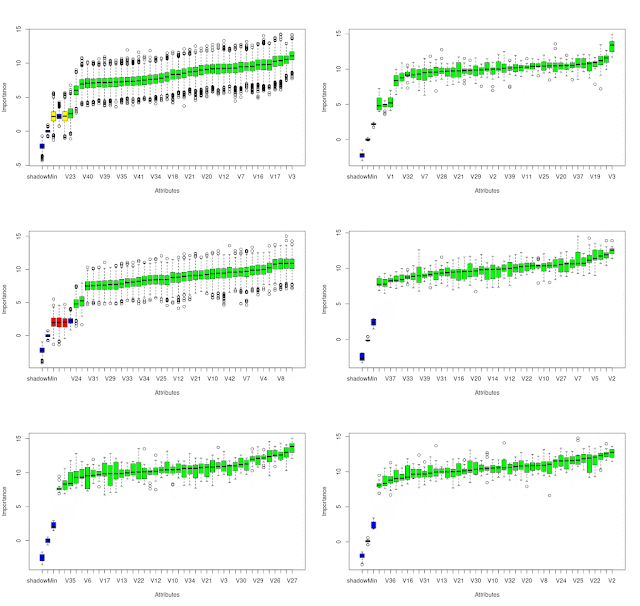
In my previous post I talked about how I planned to use constrained optimization to create features from Oanda's OrderBook and PositionBook data, which can be downloaded via their API. In addition to this I have also created a set of features based on the idea of Order Flow Imbalance (OFI), a nice exposition of which is given in this blog post along with a numerical example of how to calculate OFI. Of course Oanda's OrderBook/PositionBook data is not exactly the same as a conventional limit order book, but I thought they are similar enough to investigate using OFI on them. The result of these investigations is shown in the animated GIF below.

This shows the output from using the R Boruta package to check for the feature relevance of OFI levels to a depth of 20 of both the OrderBook and PositionBook to classify the sign of the log return of price over the periods detailed below following an OrderBook/PositionBook update (the granularity at which the OrderBook/PositionBook data can be updated is 20 minutes):

  • 20 minutes
  • 40 minutes
  • 60 minutes
  • the 20 minutes starting 20 minutes in the future
  • the 20 minutes starting 40 minutes in the future
for both the OrderBook and PositionBook, giving a total of 10 separate images/results in the above GIF.
 
Observant readers may notice that in the GIF there are 42 features being checked, but only an OFI depth of 20. The reason for this is that the data contain information about buys/sell orders and long/short positions both above and below the current price, so what I did was calculate OFI for:
  • buy orders above price vs sell orders below price
  • sell orders above price vs buy orders below price
  • long positions above price vs short positions below price
  • short positions above price vs long positions below price 
As can be seen, almost all features are deemed to be relevant with the exception of 3 OFI levels rejected (red candles) and 2 deemed tentative (yellow candles).

It is my intention to use these features in a machine learning model to classify the probability of future market direction over the time frames mentioned above. 

More in due course.

Tuesday, February 15, 2022

A Possible, New Positionbook Indicator?

A Possible, New Positionbook Indicator?

In my previous post I ended with saying that I would post about some sort of "sentiment indicator" if, and only if, I had something positive to say about my progress on this work. This post is the first on this subject.

The indicator I'm working on is based on the open position ratios data that is available via the Oanda api. For the uninitiated, this data gives the percentage of traders holding long and short positions, and at what price levels, in 14 selected forex pairs and also gold and silver. The data is updated every 20 minutes. I have long felt that there must be some value hidden in this data but the problem is how to extract it.

What I've done is take the percentage values from the (usually) hundreds of separate price levels and sum and normalise them over three defined ranges - levels above/below the high/low of each 20 minute period and the level(s) that span the price range of this period. This is done separately for long and short positions to give a total of 6 percentage figures that sum to 100%. Conceptually, this can be thought of as attaching to the open and close of a 20 minute OHLC bar the 6 percentage position values that were in force at the open and close respectively. The problem is to try and infer the actual, net changes in positions that have taken place over the time period this 20 minute bar was forming. In this way I am trying, if you like, to create a sort of  "skin in the game" indicator as opposed to an indicator derived from order book data, which could be said to be based on traders' current (changeable) intentions as expressed by their open orders and which are subject to shenanigans such as spoofing.

The methodology I've decided on to realise the above is constrained optimization using Octave's fmincon function. The objective function is simply:

    denom = X' * old_pb_net_pos ;

    J = mean( ( new_pb_net_pos .- ( ( X .* old_pb_net_pos ) ./ denom ) ).^2 ) ;

for a multiplicative position value change model where:

  • X is a vector of constants that are to be optimised
  • old_pb_net_pos is a vector of the 6 percentage values at the open
  • new_pb_net_pos is a vector of the 6 percentage values at the close

This is a constrained model because percentage position values at price levels outside the bar range cannot actually increase as a result of trades that take place within the bar range, so the X values for these levels are necessarily constrained to a maximum value of 1 (implying no real, absolute change at these levels). Similarly, all X values must be greater than zero (a zero value would imply a mass exit of all positions at this level, which never actually happens).

The net result of the above is an optimised X vector consisting of multiplicative constants that are multiplied with old_pb_net_pos to achieve new_pb_net_pos according to the logic exemplified in the above objective function. It is these optimised X values from which the underlying, real changes in positions will be inferred and features created. More on this in my next post.


Tuesday, January 4, 2022

Matrix Profile and Weakly Labelled Data - 2nd and Final Update

Matrix Profile and Weakly Labelled Data - 2nd and Final Update

It has been over three months since my last post, which was intended to be the first in a series of posts on the subject of the title of this post. However, it turned out that the results of my work were underwhelming and so I decided to stop flogging a dead horse and move onto other things. I still have some ideas for using Matrix Profile, but not for the above. These ideas may be the subject of a future blog post.

I subsequently looked at plotting order levels using the data that is available via the Oanda API and I have come up with Octave code to render plots such as this:

where the brighter yellow stripes show ranges where there is an accumulation of sell/buy orders above/below price. These can be interpreted as support/resistance areas. It is normally my practice to post my Octave code, but the code for this plot is quite idiosyncratic and depends very much on the way I have chosen to store the underlying data downloaded from Oanda. As such, I don't think it would be helpful to readers and so I am not posting the code. That said, if there is actually a demand I am more than happy to make it available in a future blog post.

Having done this, it seemed natural to extend it to Open Position Ratios which are also available via the Oanda API. Plotting these levels renders plots that are similar to the plot shown above, but show levels where open long/short positions instead of open orders are accumulated. Although such plots are visually informative, I prefer something more objective, and so for the last few weeks I have been working on using the open position ratios data to construct some sort of sentiment indicator that hopefully could give a heads up to future price movement direction. This is still very much a work in progress which I shall post about if there are noteworthy results.

More in due course.

Friday, September 17, 2021

Matrix Profile and Weakly Labelled Data - Update 1

Matrix Profile and Weakly Labelled Data - Update 1

This is the first post in a short series detailing my recent work following on from my previous post. This post will be about some problems I have had and how I partially solved them.

The main problem was simply the speed at which the code (available from the companion website) seems to run. The first stage Matrix Profile code runs in a few seconds, the second, individual evaluation stage in no more than a few minutes, but the third stage, greedy search, which uses Golden Section Search over the pattern candidates, can take many, many hours. My approach to this was simply to optimise the code to the best of my ability. My optimisations, all in the compute_f_meas.m function, are shown in the following code boxes. This while loop

i = 1;
while true

if i >= length(anno_st)
break;
endif

first_part = anno_st(1:i);
second_part = anno_st(i+1:end);
bad_st = abs(second_part - anno_st(i)) < sub_len;
second_part = second_part(~bad_st);
anno_st = [first_part; second_part;];
i = i + 1;

endwhile
is replaced by this .oct compiled version of the same while loop
#include 
#include

DEFUN_DLD ( stds_f_meas_while_loop_replace, args, nargout,
"-*- texinfo -*-\n\
@deftypefn {Function File} {} stds_f_meas_while_loop_replace (@var{input_vector,sublen})\n\
This function takes an input vector and a scalar sublen\n\
length. The function sets to zero those elements in the\n\
input vector that are closer to the preceeding value than\n\
sublen. This function replaces a time consuming .m while loop\n\
in the stds compute_f_meas.m function.\n\
@end deftypefn" )

{
octave_value_list retval_list ;
int nargin = args.length () ;

// check the input arguments
if ( nargin != 2 ) // there must be a vector and a scalar sublen
{
error ("Invalid arguments. Inputs are a column vector and a scalar value sublen.") ;
return retval_list ;
}

if ( args(0).length () < 2 )
{
error ("Invalid 1st argument length. Input is a column vector of length > 1.") ;
return retval_list ;
}

if ( args(1).length () > 1 )
{
error ("Invalid 2nd argument length. Input is a scalar value for sublen.") ;
return retval_list ;
}
// end of input checking

ColumnVector input = args(0).column_vector_value () ;
double sublen = args(1).double_value () ;
double last_iter ;

// initialise last_iter value
last_iter = input( 0 ) ;

for ( octave_idx_type ii ( 1 ) ; ii < args(0).length () ; ii++ )
{

if ( input( ii ) - last_iter >= sublen )
{
last_iter = input( ii ) ;
}
else
{
input( ii ) = 0.0 ;
}

} // end for loop

retval_list( 0 ) = input ;

return retval_list ;

} // end of function
and called thus
anno_st = stds_f_meas_while_loop_replace( anno_st , sub_len ) ;
anno_st( anno_st == 0 ) = [] ;
This for loop
is_tp = false(length(anno_st), 1);
for i = 1:length(anno_st)
if anno_ed(i) > length(label)
anno_ed(i) = length(label);
end
if sum(label(anno_st(i):anno_ed(i))) > 0.8*sub_len
is_tp(i) = true;
end
end
tp_pre = sum(is_tp);
is replaced by use of cellslices.m and cellfun.m thus
label_length = length( label ) ;
anno_ed( anno_ed > label_length ) = label_length ;
cell_slices = cellslices( label , anno_st , anno_ed ) ;
cell_sums = cellfun( @sum , cell_slices ) ;
tp_pre = sum( cell_sums > 0.8 * sub_len ) ;
and a further for loop
is_tp = false(length(pos_st), 1);
for i = 1:length(pos_st)
if sum(anno(pos_st(i):pos_ed(i))) > 0.8*sub_len
is_tp(i) = true;
end
end
tp_rec = sum(is_tp);
is replaced by
cell_slices = cellslices( anno , pos_st , pos_ed ) ;
cell_sums = cellfun( @sum , cell_slices ) ;
tp_rec = sum( cell_sums > 0.8 * sub_len ) ;

Although the above measurably improves running times, overall the code of the third stage is still sluggish. I have found that the best way to deal with this, on the advice of the original paper's author, is to limit the number of patterns to search for, the "pat_max" variable, to the minimum possible to achieve a satisfactory result. What I mean by this is that if  pat_max = 5 and the result returned also has 5 identified patterns, incrementally increase pat_max until such time that the number of identified patterns is less than pat_max. This does, by necessity, mean running the whole routine a few times, but it is still quicker this way than drastically over estimating pat_max, i.e. choosing a value of say 50 to finally identify maybe only 5/6 patterns.

More in due course.

Friday, August 27, 2021

Another Iterative Improvement of my Volume/Market Profile Charts

Another Iterative Improvement of my Volume/Market Profile Charts

Below is a screenshot of this new chart version, of today's (Friday's) price action at a 10 minute bar scale:

Just by looking at the chart it might not be obvious to readers what has changed, so the changes are detailed below.

The first change is in how the volume profile (the horizontal histogram on the left) is calculated. The "old" version of the chart calculates the profile by assuming the "model" that tick volume for each 10 minute bar is normally distributed across the high/low range of the bar, and then the profile histogram is the accumulation of these individual, 10 minute, normally distributed "mini profiles." A more complete description of this is given in my Market Profile Chart in Octave blog post, with code.

The new approach is more data centric rather than model based. Every 10 minutes, instead of downloading the 10 minute OHLC and tick volume, the last 10 minutes worth of 5 second OHLC and tick volume is downloaded. The whole tick volume of each 5 second period is assigned to a price level equivalent to the Typical price (rounded to the nearest pip) of said 5 second period, and the volume profile is then the accumulation of these volume ticks per price level. I think this is a much more accurate reflection of the price levels at which tick volume actually occurred compared to the old, model based charts. This second screenshot is of the old chart over the exact same price data as the first, improved version of the chart.

It can be seen that the two volume profile histograms of the respective charts differ from each other in terms of their overall shape and the number and price levels of peaks (Points of Control) and troughs (Low Volume Nodes).

The second change in the new chart is in how the background heatmap is plotted. The heatmap is a different presentation of the volume profile whereby higher volume price levels are shown by the brighter yellow colours. The old chart only displays the heatmap associated with the latest calculated volume profile histogram, which is projected back in time. This is, of course, a form of lookahead bias when plotting past prices over the latest heatmap. The new chart solves this by plotting a "rolling" version of the heatmap which reflects the volume profile that was in force at the time each 10 minute OHLC candle formed. It is easy to see how the Points of Control and Low Volume Nodes price levels ebb and flow throughout the trading day.

The third change, which naturally followed on from the downloading of 5 second data, is in the plotting of the candlesticks. Rather than having a normal, open to close candlestick body, the candlesticks show the "mini volume profiles" of the tick volume within each bar, plotted via Octave's patch function. The white candlestick wicks indicate the usual high/low range, and the open and close levels are shown by grey and black dots respectively. This is more clearly seen in the zoomed in screenshot below.

I wanted to plot these types of bars because recently I have watched some trading webcasts, which talked about "P", "b" and "D" shaped bar profiles at "areas of interest." The upshot of these webcasts is that, in general, a "P" bar is bullish, a "b" is bearish and a "D" is "in balance" when they intersect an "area of interest" such as Point of Control, Low Volume Node, support and resistance etc. This is supposed to be indicative of future price direction over the immediate short term. With this new version of chart, I shall be in a position to investigate these claims for myself.

Friday, February 5, 2021

A Forex Pair Snapshot Chart

A Forex Pair Snapshot Chart

After yesterday's Heatmap Plot of Forex Temporal Clustering post I thought I would consolidate all the chart types I have recently created into one easy, snapshot overview type of chart. Below is a typical example of such a chart, this being today's 10 minute EUR_USD forex pair chart up to a few hours after the London session close (the red vertical line).


The top left chart is a Market/Volume Profile Chart with added rolling Value Area upper and lower bounds (the cyan, red and white lines) and also rolling Volume Weighted Average Price with upper and lower standard deviation lines (magenta).

The bottom left chart is the turning point heatmap chart as described in yesterday's post.

The two rightmost charts are also Market/Volume Profile charts, but of my Currency Strength Candlestick Charts based on my Currency Strength Indicator. The upper one is the base currency, i.e. EUR, and the lower is the quote currency. 

The following charts are the same day's charts for:

GBP_USD,

USD_CHF
and finally USD_JPY
The regularity of the turning points is easily seen in the lower lefthand charts although, of course, this is to be expected as they all share the USD as a common currency. However, there are also subtle differences to be seen in the "shadows" of the lighter areas.

For the nearest future my self-assigned task will be to observe the forex pairs, in real time, through the prism of the above style of chart and do some mental paper trading, and perhaps some really small size, discretionary live trading, in additional to my normal routine of research and development.


Thursday, February 4, 2021

Heatmap Plot of Forex Temporal Clustering of Turning Points

Heatmap Plot of Forex Temporal Clustering of Turning Points

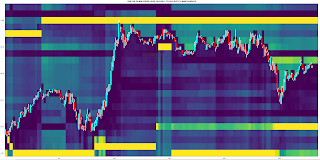
Following up on my previous post, below is the chart of the temporal turning points that I have come up with.

This particular example happens to be 10 minute candlesticks over the last two days of the GBP_USD forex pair.

The details I have given about various turning points over the course of my last few posts have been based on identifying the "ix" centre value of turning point clusters. However, for plotting purposes I felt that just displaying these ix values wouldn't be very illuminating. Instead, I have taken the approach of displaying a sort of distribution of turning points per cluster. I would refer readers to my temporal clustering part 3 post wherein there is a coloured histogram of the R output of the clustering algorithm used. What I have done for the heatmap background of the above chart is normalise each separate, coloured histogram by the maximum value within the cluster and then plotted these normalised cluster values using Octave's pcolor function. An extra step taken was to raise the values to the power four just to increase the contrast within and between the sequential histogram backgrounds.

Each normalised histogram has a single value of one, which is shown by the bright yellow vertical lines, one per cluster. This represents the time of day at which, within the cluster window, the greatest number of turns occured in the historical lookback period. The darker green lines show other times within the cluster at which other turns occured.

The hypothesis behind this is that there are certain times of the day when price is more likely to change direction, a turning point, than at other times. Such times are market opens, closes etc. and the above chart is a convenient visual representation of these times. The lighter the backgound, the greater the probability that such a turn will occur, based upon the historical record of such turn timings.

Enjoy!
 

Saturday, January 30, 2021

Temporal Clustering Times on Forex Majors Pairs

Temporal Clustering Times on Forex Majors Pairs

In the following code box there are the results from the temporal clustering routine of my last few posts on the four forex majors pairs of EUR_USD, GBP_USD, USD_CHF and USD_JPY.

###### EUR_USD 10 minute bars #######
## In the following order
## Both Delta turning point filter and "normal" TPF combined ##
## Delta turning point filter only ##
## "Normal" turning point filter only

###################### Monday ##############################################
K_opt == 8, ix values == 13 38 63 89 112 135 162 186 ## averaged over all 15 n_bars 1 to 15 inclusive
00 4:10 8:20 12:40 16:30 20:20 00:50 4:50

K_opt == 8, ix values == 13 39 64 89 112 135 161 186 ## averaged over n_bars 1 to 6 inclusive ( upto and include 1 hour )

K_opt == 5, ix_values == 21 60 97 134 175 ## averaged over n_bars 7 to 15 inclusive ( over 1 hour )
K == 6, ix values == 21 59 94 125 158 184

K_opt == 11, ix values == 9 26 43 60 78 95 113 132 151 169 185 ## averaged over all 15 n_bars 1 to 15 inclusive

K_opt == 8, ix values == 13 36 61 86 111 136 161 186 ## averaged over n_bars 1 to 6 inclusive ( upto and include 1 hour )

K_opt == 8, ix values == 13 34 61 87 110 137 164 187 ## averaged over n_bars 7 to 15 inclusive ( over 1 hour )

K_opt == 8, ix values == 13 38 63 88 112 137 162 186 ## averaged over all 15 n_bars 1 to 15 inclusive

K_opt == 10, ix values == 10 31 52 72 91 112 131 150 169 188 ## averaged over n_bars 1 to 6 inclusive ( upto and include 1 hour )

K_opt == 8, ix values == 12 35 62 88 112 137 164 187 ## averaged over n_bars 7 to 15 inclusive ( over 1 hour )

###################### Tuesday #############################################
K_opt == 6, ix values == 131 169 206 244 283 322 ## averaged over all 15 n_bars 1 to 15 inclusive
19:40 02:00 8:10 14:30 21:00 03:30

K_opt == 6, ix values == 131 170 207 245 284 323 ## averaged over n_bars 1 to 6 inclusive ( upto and include 1 hour )

K_opt == 7, ix values == 131 168 206 243 274 305 330 ## averaged over n_bars 7 to 15 inclusive ( over 1 hour )

K_opt == 11, ix values == 124 143 164 184 205 226 247 268 289 310 331 ## averaged over all 15 n_bars 1 to 15 inclusive

K_opt == 11, ix values == 124 144 164 185 204 225 246 267 288 309 332 ## averaged over n_bars 1 to 6 inclusive ( upto and include 1 hour )

K_opt == 7, ix values = 133 169 206 241 273 304 329 ## averaged over n_bars 7 to 15 inclusive ( over 1 hour )

K_opt == 9, ix values == 127 152 175 202 228 253 278 305 330 ## averaged over all 15 n_bars 1 to 15 inclusive

K_opt == 9, ix values == 127 152 177 202 228 253 278 304 329 ## averaged over n_bars 1 to 6 inclusive ( upto and include 1 hour )

K_opt == 7, ix values == 132 168 205 242 273 304 329 ## averaged over n_bars 7 to 15 inclusive ( over 1 hour )

###################### Wednesday ###########################################
K_opt == 6, ix values == 275 312 351 389 426 465 ## averaged over all 15 n_bars 1 to 15 inclusive
19:40 01:50 08:20 14:40 20:50 03:20

K_opt == 6, ix values == 275 313 352 391 428 466 ## averaged over n_bars 1 to 6 inclusive ( upto and include 1 hour )

K_opt == 6, ix values == 274 312 350 389 424 463 ## averaged over n_bars 7 to 15 inclusive ( over 1 hour )

K_opt == 9, ix values == 272 299 322 347 372 397 422 449 474 ## averaged over all 15 n_bars 1 to 15 inclusive

K_opt == 11, ix values == 268 288 308 329 348 369 390 411 432 453 476 ## averaged over n_bars 1 to 6 inclusive ( upto and include 1 hour )

K_opt == 6, ix values == 275 312 351 388 424 463 ## averaged over n_bars 7 to 15 inclusive ( over 1 hour )

K_opt == 9, ix values == 272 297 322 348 373 398 423 449 474 ## averaged over all 15 n_bars 1 to 15 inclusive

K_opt == 9, ix values == 271 297 322 348 373 398 423 448 473 ## averaged over n_bars 1 to 6 inclusive ( upto and include 1 hour )

K_opt == 6, ix values == 276 311 350 389 426 465 ## averaged over n_bars 7 to 15 inclusive ( over 1 hour )

####################### Thursday ###########################################
K_opt == 6, ix values == 420 457 495 532 570 609 ## averaged over all 15 n_bars 1 to 15 inclusive
19:50 02:00 08:20 14:30 20:50 03:20

K_opt == 6, ix values == 420 457 494 531 570 610 ## averaged over n_bars 1 to 6 inclusive ( upto and include 1 hour )

K_opt == 6, ix values == 420 457 495 532 568 607 ## averaged over n_bars 7 to 15 inclusive ( over 1 hour )

K_opt == 9, ix values == 416 443 466 492 518 543 568 593 618 ## averaged over all 15 n_bars 1 to 15 inclusive

K_opt == 10, ix values == 414 437 460 483 506 527 550 573 596 619 ## averaged over n_bars 1 to 6 inclusive ( upto and include 1 hour )

K_opt == 9, ix values == 416 443 466 493 520 543 568 595 618 ## averaged over n_bars 7 to 15 inclusive ( over 1 hour )

K_opt == 9, ix values == 415 440 465 492 518 543 568 593 618 ## averaged over all 15 n_bars 1 to 15 inclusive

K_opt == 9, ix values == 415 440 465 492 518 543 568 593 618 ## averaged over n_bars 1 to 6 inclusive ( upto and include 1 hour )

K_opt == 7, ix values == 420 457 494 529 561 592 617 ## averaged over n_bars 7 to 15 inclusive ( over 1 hour )

####################### Friday #############################################
K_opt == 5, ix values == 564 599 635 670 703 ## averaged over all 15 n_bars 1 to 15 inclusive
19:50 01:40 07:40 13:30 19:00

K_opt == 6, ix values == 563 596 627 654 680 707 ## averaged over n_bars 1 to 6 inclusive ( upto and include 1 hour )
K == 5, ix values == 564 599 635 668 703

K_opt == 5, ix values == 564 601 639 674 705 ## averaged over n_bars 7 to 15 inclusive ( over 1 hour )

K_opt == 9, ix values == 556 575 595 614 633 652 672 691 711 ## averaged over all 15 n_bars 1 to 15 inclusive

K_opt == 11, ix values == 554 570 587 602 619 634 651 667 682 698 713 ## averaged over n_bars 1 to 6 inclusive ( upto and include 1 hour )

K_opt == 9, ix values == 556 575 595 614 633 652 671 691 711 ## averaged over n_bars 1 to 6 inclusive ( upto and include 1 hour )

K_opt == 9, ix values == 556 575 596 613 634 652 672 691 711 ## averaged over n_bars 7 to 15 inclusive ( over 1 hour )

K_opt == 9, ix values == 556 575 594 613 633 652 672 691 710 ## averaged over all 15 n_bars 1 to 15 inclusive

K_opt == 9, ix values == 556 575 594 613 634 653 672 691 710 ## averaged over n_bars 1 to 6 inclusive ( upto and include 1 hour )

K_opt == 5, ix values == 564 600 637 674 705 ## averaged over n_bars 7 to 15 inclusive ( over 1 hour )

############################################################################

###### GBP_USD 10 minute bars #######
## In the following order
## Both Delta turning point filter and "normal" TPF combined ##

###################### Monday ##############################################
K_opt = 8, ix_values = 13 36 61 86 111 136 162 186 ## averaged over all 15 n_bars 1 to 15 inclusive
0:00 3:50 8:00 12:10 16:20 20:30 0:50 4:50

K_opt = 9, ix_values = 12 34 56 78 99 120 141 164 187 ## averaged over n_bars 1 to 6 inclusive ( upto and include 1 hour )

K_opt = 8, ix_values = 12 35 61 86 110 136 163 186 ## averaged over n_bars 7 to 15 inclusive ( over 1 hour )

###################### Tuesday #############################################
K_opt = 12, ix_values = 124 143 162 180 199 216 235 254 274 293 312 332 ## averaged over all 15 n_bars 1 to 15 inclusive
18:30 21:40 0:50 3:50 7:00 9:50 13:00 16:10 19:30 22:40 1:50 5:10

K_opt = 11, ix_values = 124 143 164 185 206 227 248 269 290 311 332 ## averaged over n_bars 1 to 6 inclusive ( upto and include 1 hour )

K_opt = 9, ix_values = 128 154 177 205 230 254 279 307 330 ## averaged over n_bars 7 to 15 inclusive ( over 1 hour )

###################### Wednesday ###########################################
K_opt = 11, ix_values = 269 290 311 331 352 373 394 415 434 455 476 ## averaged over all 15 n_bars 1 to 15 inclusive
18:40 22:10 1:40 5:00 8:30 12:00 15:30 19:00 22:10 1:40 5:10

K_opt = 11, ix_values = 269 289 310 330 351 372 393 413 434 455 476 ## averaged over n_bars 1 to 6 inclusive ( upto and include 1 hour )

K_opt = 8, ix_values = 275 310 341 367 394 422 451 475 ## averaged over n_bars 7 to 15 inclusive ( over 1 hour )

###################### Thursday ############################################
K_opt = 9, ix_values = 415 440 465 492 517 542 568 594 618 ## averaged over all 15 n_bars 1 to 15 inclusive
19:00 23:10 3:20 7:50 12:00 16:10 20:30 0:50 4:50

K_opt = 9, ix_values = 415 440 465 491 517 542 568 593 618 ## averaged over n_bars 1 to 6 inclusive ( upto and include 1 hour )

K_opt = 9, ix_values = 416 441 464 492 519 542 569 596 619 ## averaged over n_bars 7 to 15 inclusive ( over 1 hour )

###################### Friday ##############################################
K_opt = 9, ix_values = 557 576 595 614 633 652 671 690 711 ## averaged over all 15 n_bars 1 to 15 inclusive
18:40 21:50 1:00 4:10 7:20 10:30 13:40 16:50 20:20

K_opt = 9, ix_values = 557 576 595 614 633 652 671 691 711 ## averaged over n_bars 1 to 6 inclusive ( upto and include 1 hour )

K_opt = 8, ix_values = 557 576 599 621 642 665 686 709 ## averaged over n_bars 7 to 15 inclusive ( over 1 hour )

############################################################################

###### USD_CHF 10 minute bars #######
## In the following order
## Both Delta turning point filter and "normal" TPF combined ##

###################### Monday ##############################################
K_opt = 11, ix_values = 8 25 42 61 79 96 113 131 150 169 188 ## averaged over all 15 n_bars 1 to 15 inclusive
23:10 2:00 4:50 8:00 11:00 13:50 16:40 19:40 22:50 2:00 5:10

K_opt = 11, ix_values = 9 26 43 60 79 96 114 133 151 170 189 ## averaged over n_bars 1 to 6 inclusive ( upto and include 1 hour )

K_opt = 7, ix_values = 13 38 66 99 127 157 184 ## averaged over n_bars 7 to 15 inclusive ( over 1 hour )

###################### Tuesday #############################################
K_opt = 9, ix_values = 127 152 177 202 228 253 279 306 330 ## averaged over all 15 n_bars 1 to 15 inclusive
19:00 23:10 3:20 7:30 11:50 16:00 20:20 0:50 4:50

K_opt = 11, ix_values = 124 144 165 185 204 225 246 267 288 309 331 ## averaged over n_bars 1 to 6 inclusive ( upto and include 1 hour )

K_opt = 7, ix_values = 133 170 205 240 270 301 328 ## averaged over n_bars 7 to 15 inclusive ( over 1 hour )

###################### Wednesday ###########################################
K_opt = 10, ix_values = 270 293 316 342 365 388 411 432 454 475 ## averaged over all 15 n_bars 1 to 15 inclusive
18:50 22:40 2:30 6:50 10:40 14:30 18:20 21:50 1:30 5:00

K_opt = 12, ix_values = 268 287 308 327 346 365 384 401 420 439 458 477 ## averaged over n_bars 1 to 6 inclusive ( upto and include 1 hour )

K_opt = 7, ix_values = 276 313 349 383 414 444 471 ## averaged over n_bars 7 to 15 inclusive ( over 1 hour )

###################### Thursday ############################################
K_opt = 11, ix_values = 413 432 452 471 491 512 533 554 575 598 619 ## averaged over all 15 n_bars 1 to 15 inclusive
18:40 21:50 1:10 4:20 7:40 11:10 14:40 18:10 21:40 1:30 5:00

K_opt = 12, ix_values = 412 431 450 469 488 507 526 545 563 582 601 621 ## averaged over n_bars 1 to 6 inclusive ( upto and include 1 hour )

K_opt = 9, ix_values = 415 440 463 491 518 543 570 597 619 ## averaged over n_bars 7 to 15 inclusive ( over 1 hour )

###################### Friday ##############################################
K_opt = 9, ix_values = 557 576 596 615 634 653 672 691 710 ## averaged over all 15 n_bars 1 to 15 inclusive
18:40 21:50 1:10 4:20 7:30 10:40 13:50 17:00 20:10

K_opt = 9, ix_values = 556 575 595 614 633 652 671 690 710 ## averaged over n_bars 1 to 6 inclusive ( upto and include 1 hour )

K_opt = 7, ix_values = 558 579 602 629 652 677 705 ## averaged over n_bars 7 to 15 inclusive ( over 1 hour )

############################################################################

###### USD_JPY 10 minute bars #######
## In the following order
## Both Delta turning point filter and "normal" TPF combined ##

###################### Monday ##############################################
K_opt = 12, ix_values = 8 24 41 58 73 90 107 124 141 158 173 190 ## averaged over all 15 n_bars 1 to 15 inclusive
23:10 1:50 4:40 7:30 10:00 12:50 15:40 18:30 21:20 0:10 2:40 5:30

K_opt = 12, ix_values = 8 24 41 56 73 90 107 124 141 158 173 190 ## averaged over n_bars 1 to 6 inclusive ( upto and include 1 hour )

K_opt = 5, ix_values = 20 60 99 136 175 ## averaged over n_bars 7 to 15 inclusive ( over 1 hour )

###################### Tuesday #############################################
K_opt = 9, ix_values = 128 154 179 204 229 254 279 306 331 ## averaged over all 15 n_bars 1 to 15 inclusive
19:10 23:30 3:40 7:50 12:00 16:10 20:20 0:50 5:00

K_opt = 9, ix_values = 128 153 178 203 228 254 279 305 330 ## averaged over n_bars 1 to 6 inclusive ( upto and include 1 hour )

K_opt = 7, ix_values = 133 168 205 240 271 302 329 ## averaged over n_bars 7 to 15 inclusive ( over 1 hour )

###################### Wednesday ###########################################
K_opt = 11, ix_values = 269 289 310 331 352 373 394 414 433 454 476 ## averaged over all 15 n_bars 1 to 15 inclusive
18:40 22:00 1:30 5:00 8:30 12:00 15:30 18:50 22:00 1:30 5:10

K_opt = 9, ix_values = 272 297 322 348 374 399 424 449 474 ## averaged over n_bars 1 to 6 inclusive ( upto and include 1 hour )

K_opt = 10, ix_values = 269 288 309 331 352 376 398 423 450 475 ## averaged over n_bars 7 to 15 inclusive ( over 1 hour )

###################### Thursday ############################################
K_opt = 9, ix_values = 416 442 467 492 518 543 568 593 618 ## averaged over all 15 n_bars 1 to 15 inclusive
19:10 23:30 3:40 7:50 12:10 16:20 20:30 0:40 4:50

K_opt = 12, ix_values = 412 431 450 469 488 507 526 545 564 583 602 621 ## averaged over n_bars 1 to 6 inclusive ( upto and include 1 hour )

K_opt = 7, ix_values = 420 455 492 527 560 591 618 ## averaged over n_bars 7 to 15 inclusive ( over 1 hour )

###################### Friday ##############################################
K_opt = 7, 8 or 9
ix_values 7 = 561 588 613 638 663 686 709 ## averaged over all 15 n_bars 1 to 15 inclusive
ix_values 8 = 557 578 599 622 643 666 687 710
ix_values 9 = 557 576 596 616 635 653 672 691 711 ## timings are for this bottom row
18:40 21:50 1:10 4:30 7:40 10:40 13:50 17:00 20:20

K_opt = 8, ix_values = 558 579 600 621 644 665 687 709 ## averaged over n_bars 1 to 6 inclusive ( upto and include 1 hour )

K_opt = 6, ix_values = 563 594 621 646 676 705 ## averaged over n_bars 7 to 15 inclusive ( over 1 hour )

############################################################################

This is based on 10 minute bars over the last year or so. Readers should read my last few previous posts for background.

The first set of results, EUR_USD, are what the charts of my previous posts were based on and include combined results of my "Delta Turning Point Filter" and "Normal Turning Point Filter" and the results for each filter separately. Since there doesn't appear to be significant differences between these, the other three pairs' results are the combined filter results only.

The K_opt variable is the optimal number of clusters (see my temporal-clustering-part-3 post for how "optimal" is decided) and the ix_values are also described in this post. For convenience the first set of ix_values per day have the relevant times anotated underneath and therefore it is a simple matter to count forwards/backwards in 10 minute increments to place times to the other ix_values. The variable n_bars is an input to the turning point filter functions and essentially indicates the lookback/lookforward period (n_bar == 2 would mean 2 x 10 minute periods) used for determining a local high/low according to each function's logic.

As to how to interpret this, a typical sequence of times per day might look like this:

18:40 22:00 1:30 5:00 8:30 12:00 15:30 18:50 22:00 1:30 5:10

where the highlighted times represent the BST times for the period covering the London session open to the New York session close for one day. The preceding and following times are the two "book-ending" Asian sessions. 

Close inspection of these results reveals some surprising regularities. In even just the above single example (an actual copy and paste of a code box example) there appear to be definite times per day at which a local high/low occurs. I hopefully will be able to incorporate this into some type of chart for a nice visual presentation of the data. 

More in due course. Enjoy.