Showing posts with label R. Show all posts

Friday, March 25, 2022

OrderBook and PositionBook Features

OrderBook and PositionBook Features

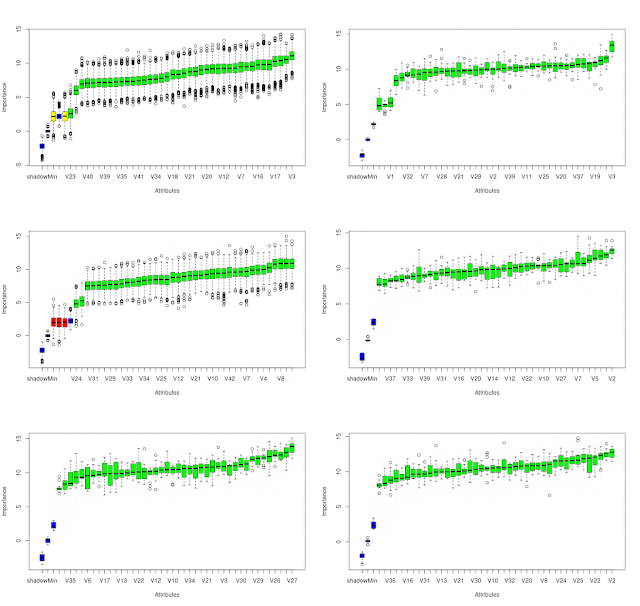
In my previous post I talked about how I planned to use constrained optimization to create features from Oanda's OrderBook and PositionBook data, which can be downloaded via their API. In addition to this I have also created a set of features based on the idea of Order Flow Imbalance (OFI), a nice exposition of which is given in this blog post along with a numerical example of how to calculate OFI. Of course Oanda's OrderBook/PositionBook data is not exactly the same as a conventional limit order book, but I thought they are similar enough to investigate using OFI on them. The result of these investigations is shown in the animated GIF below.

This shows the output from using the R Boruta package to check for the feature relevance of OFI levels to a depth of 20 of both the OrderBook and PositionBook to classify the sign of the log return of price over the periods detailed below following an OrderBook/PositionBook update (the granularity at which the OrderBook/PositionBook data can be updated is 20 minutes):

  • 20 minutes
  • 40 minutes
  • 60 minutes
  • the 20 minutes starting 20 minutes in the future
  • the 20 minutes starting 40 minutes in the future
for both the OrderBook and PositionBook, giving a total of 10 separate images/results in the above GIF.
 
Observant readers may notice that in the GIF there are 42 features being checked, but only an OFI depth of 20. The reason for this is that the data contain information about buys/sell orders and long/short positions both above and below the current price, so what I did was calculate OFI for:
  • buy orders above price vs sell orders below price
  • sell orders above price vs buy orders below price
  • long positions above price vs short positions below price
  • short positions above price vs long positions below price 
As can be seen, almost all features are deemed to be relevant with the exception of 3 OFI levels rejected (red candles) and 2 deemed tentative (yellow candles).

It is my intention to use these features in a machine learning model to classify the probability of future market direction over the time frames mentioned above. 

More in due course.

Friday, February 5, 2021

A Forex Pair Snapshot Chart

A Forex Pair Snapshot Chart

After yesterday's Heatmap Plot of Forex Temporal Clustering post I thought I would consolidate all the chart types I have recently created into one easy, snapshot overview type of chart. Below is a typical example of such a chart, this being today's 10 minute EUR_USD forex pair chart up to a few hours after the London session close (the red vertical line).


The top left chart is a Market/Volume Profile Chart with added rolling Value Area upper and lower bounds (the cyan, red and white lines) and also rolling Volume Weighted Average Price with upper and lower standard deviation lines (magenta).

The bottom left chart is the turning point heatmap chart as described in yesterday's post.

The two rightmost charts are also Market/Volume Profile charts, but of my Currency Strength Candlestick Charts based on my Currency Strength Indicator. The upper one is the base currency, i.e. EUR, and the lower is the quote currency. 

The following charts are the same day's charts for:

GBP_USD,

USD_CHF
and finally USD_JPY
The regularity of the turning points is easily seen in the lower lefthand charts although, of course, this is to be expected as they all share the USD as a common currency. However, there are also subtle differences to be seen in the "shadows" of the lighter areas.

For the nearest future my self-assigned task will be to observe the forex pairs, in real time, through the prism of the above style of chart and do some mental paper trading, and perhaps some really small size, discretionary live trading, in additional to my normal routine of research and development.


Thursday, February 4, 2021

Heatmap Plot of Forex Temporal Clustering of Turning Points

Heatmap Plot of Forex Temporal Clustering of Turning Points

Following up on my previous post, below is the chart of the temporal turning points that I have come up with.

This particular example happens to be 10 minute candlesticks over the last two days of the GBP_USD forex pair.

The details I have given about various turning points over the course of my last few posts have been based on identifying the "ix" centre value of turning point clusters. However, for plotting purposes I felt that just displaying these ix values wouldn't be very illuminating. Instead, I have taken the approach of displaying a sort of distribution of turning points per cluster. I would refer readers to my temporal clustering part 3 post wherein there is a coloured histogram of the R output of the clustering algorithm used. What I have done for the heatmap background of the above chart is normalise each separate, coloured histogram by the maximum value within the cluster and then plotted these normalised cluster values using Octave's pcolor function. An extra step taken was to raise the values to the power four just to increase the contrast within and between the sequential histogram backgrounds.

Each normalised histogram has a single value of one, which is shown by the bright yellow vertical lines, one per cluster. This represents the time of day at which, within the cluster window, the greatest number of turns occured in the historical lookback period. The darker green lines show other times within the cluster at which other turns occured.

The hypothesis behind this is that there are certain times of the day when price is more likely to change direction, a turning point, than at other times. Such times are market opens, closes etc. and the above chart is a convenient visual representation of these times. The lighter the backgound, the greater the probability that such a turn will occur, based upon the historical record of such turn timings.

Enjoy!