Showing posts with label Data. Show all posts

Friday, March 3, 2023

Applying Corrective AI to Daily Seasonal Forex Trading

Applying Corrective AI to Daily Seasonal Forex Trading


By
Sergei Belov, Ernest
Chan, Nahid Jetha, and
Akshay Nautiyal


ABSTRACT


We applied
Corrective
AI (Chan, 2022) to a trading model that takes
advantage of the intraday seasonality of forex returns. Breedon and Ranaldo
(2012)  observed that foreign currencies
depreciate vs. the US dollar during their local working hours and appreciate
during the local working hours of the US dollar. We first backtested the
results of Breedon and Ranaldo on recent EURUSD data from September 2021 to
January 2023 and then applied Corrective AI to this trading strategy to achieve
a significant increase in performance.


Breedon and Ranaldo (2012) described a trading strategy that shorted EURUSD during European working hours (3 AM ET to 9 AM ET,where ET denotes the local time in New York, accounting for daylight savings) and bought EURUSD during US working hours (11 AM ET to 3 PM ET). The rationale is that large-scale institutional buying of the US dollar takes place during European working hours to pay global invoices and the reverse happens during US working hours. Hence this effect is also called the “invoice effect".

There is some supportive evidence for the time-of-the-day patterns in various measures of the forex market like volatility (see Baille and Bollerslev(1991), or Andersen and Bollerslev(1998)), turnover (see Hartman (1999), or Ito and Hashimoto(2006)), and return (see Cornett(1995), or Ranaldo(2009)).  Essentially,local currencies depreciate during their local working hours for each of these measures and appreciate during the working hours of the United States.

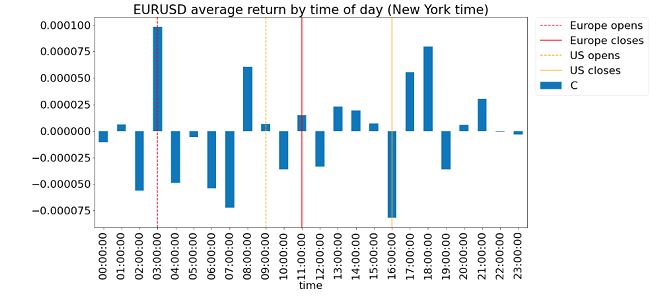
Figure 1 below describes the average hourly return of each hour in the day over a period starting from 2019-10-01 17:00 ET to 2021-09-01 16:00 ET. It reveals the pattern of returns in EURUSD. The return
pattern in the above-described “working hours'' reconciles with the hypothesis of a prevalent “invoice effect” broadly. Returns go down during European working and up during US working hours.

Figure
1: Average EURSUD return by time of day (New York time)

As this strategy was published in 2012, it offers ample time for true out-of-sample testing. We collected 1-minute bar data of EURUSD from Electronic Broking Services (EBS) and performed a backtest over the out-of-sample period October 2021-January 2023. The Sharpe Ratio of the strategy in this period is  0.88, with average annual returns of 3.5% and a maximum drawdown of -3.5%. The alpha of the strategy apparently endured. (For the purpose of this article, no transaction costs are included in the backtest because our only objective is to compare the performances with and without Corrective AI, not to determine if this trading strategy is viable in live production.)

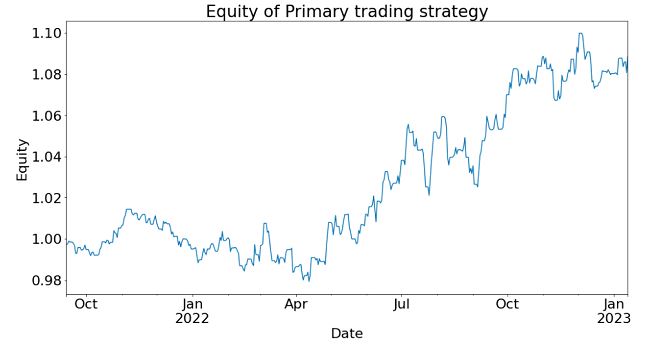
Figure 2 below shows the equity curve (“growth of $1”) of the strategy during the aforementioned out-of-sample period. The cumulative returns during this period are just below 8%. We call this the “Primary” trading strategy, for reasons that will become clear below.
Figure

2: Equity curve of Primary trading strategy in out-of-sample period


What is Corrective AI?

Suppose
we have a trading model (like the Primary trading strategy described above) for setting the side of the bet (long or short). We just need to learn the size of that bet, which includes the possibility of no bet at all (zero sizes). This is a situation that practitioners face regularly. A machine learning algorithm (ML) can be trained to determine that. To emphasize, we do not want the ML algorithm to learn or predict the side, just to tell us what is the appropriate size.

We call this problem meta-labeling (Lopez de Prado, 2018) or Corrective AI (Chan, 2022) because we want to build a secondary ML model that learns how to use a primary trading model.

We train an ML algorithm to compute the “Probability of Profit” (PoP) for the next minute-bar. If the PoP is greater than 0.5, we will set the bet size to 1; otherwise we will set it to 0. In other words, we adopt the step function as the bet sizing function that takes PoP as an input and gives the bet size as an
output, with the threshold set at 0.5.  This bet sizing function decides whether to take the bet or pass, a
purely binary prediction.

The training period was from 2019-01-01 to 2021-09-30 while the out-of-sample test period was from 2021-10-01 to 2023-01-15, consistent with the out-of-sample period we reported for the Primary trading strategy. The model used to train ML algorithm was done using the predictnow.ai Corrective AI (CAI) API, with more than a hundred pre-engineered input features (predictors). The underlying learning algorithm is a gradient-boosting decision tree.

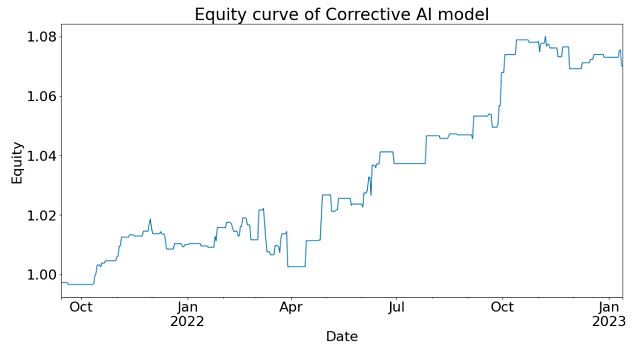
After applying Corrective AI, the Sharpe Ratio of the strategy in this period is 1.29  (an increase of 0.41), with average annual returns of 4.1% (an increase of 0.6%)  and a maximum drawdown of -1.9%
(a decrease of 1.6%). The alpha of the strategy is significantly improved.

The equity curve of the Corrective AI filtered secondary model signal can be seen in the figure below.
Figure
3: Equity curve of Corrective AI model  in out-of-sample period


Features used to train the Corrective AI model include technical indicators generated from indices, equities, futures, and options markets. Many of these features were created using Algoseek’s high-frequency futures and equities data. More discussions of these features can be found in (Nautiyal & Chan, 2021).

Conclusion:

By applying Corrective AI to the time-of-the-day Primary strategy, we were able to improve the Sharpe ratio and reduce drawdown during the out-of-sample backtest period. This aligns with observations made in the literature on meta-labeling for our primary strategies. The Corrective AI model's signal filtering capabilities do enhance performance in specific scenarios.

Acknowledgment

We are grateful to Chris Bartlett of Algoseek, who generously provided much of the high-frequency data for our feature engineering in our Corrective AI system. We also thank Pavan Dutt for his assistance with feature engineering and to Jai Sukumar for helping us use the Predictnow.ai CAI API. Finally, we express our appreciation to Erik MacDonald and Jessica Watson for their contributions in explaining this technology to Predictnow.ai’s clients

References

Breedon,
F., & Ranaldo, A. (2012, April 3). Intraday
Patterns in FX Returns and Order Flow
. https://ssrn.com/abstract=2099321

Chan,
E. (2022, June 9). What is Corrective AI?
PredictNow.ai. Retrieved February 23, 2023, from
https://predictnow.ai/what-is-corrective-ai/

Lopez
de Prado, M. (2018). Advances in
Financial Machine Learning
. Wiley.

Nautiyal,
A., & Chan, E. (2021). New Additions
to the PredictNow.ai Factor Zoo
. PredictNow.ai. Retrieved February 28,
2023, from https://predictnow.ai/new-additions-to-the-predictnow-ai-factor-zoo/

Friday, November 11, 2022

A New PositionBook Chart Type

A New PositionBook Chart Type

It has been almost 6 months since I last posted, due to working on a house renovation. However, I have still been thinking about/working on stuff, particularly on analysis of open position ratios. I had tried using this data as features for machine learning, but my thinking has evolved somewhat and I have reduced my ambition/expectation for this type of data.

Before I get into this I'd like to mention Trader Dale (I have no affiliation with him) as I have recently been following his volume profile set-ups, a screenshot of one being shown below.

This shows recent Wednesday action in the EUR_GBP pair on a 30 minute chart. The flexible volume profile set-up Trader Dale describes is called a Volume Accumulation Set-up which occurs immediately prior to a big break (in this case up). The whole premise of this particular set-up is that the volume accumulation area will be future support, off of which price will bounce, as shown by the "hand drawn" lines. Below is shown my version of the above chart
with a bit of extra price action included. The horizontal yellow lines show the support area.

Now here is the same data, but in what I'm calling a PositionBook chart, which uses Oanda's Position Level data downloaded via their API.

The blue (red) horizontal lines show the levels at which traders are net long (short) in terms of positions actually entered/held. The brighter the colours the greater the difference between the longs/shorts. It is obvious that the volume accumulation set-up area is showing a net accumulation of long positions and this is an indication of the direction of the anticipated breakout long before it happens. The Trader Dale set-up presumes an accumulation of longs because of the resultant breakout direction and doesn't seem to provide an opportunity to participate in the breakout itself!

The next chart shows the action of the following day and a bit where the price does indeed come back down to the "support" area but doesn't result in an immediate bounce off the support level. The following order level chart perhaps shows why there was no bounce - the relative absence of open orders at that level.

The equivalent PositionBook chart, including a bit more price action,
shows that after price fails to bounce off the support level it does recover back into it and then even more long positions are accumulated (the darker blue shade) at the support level during the London open, again allowing one to position oneself for the ensuing rise during the London morning session, followed by another long accumulation during the New York opening session for a following leg up into the London close (the last vertical red line).

This purpose of this post is not to criticise the Trader Dale set-up but rather to highlight the potential value-add of these new PositionBook charts. They seem to hold promise for indicating price direction and I intend to continue investigating/improving them in the coming weeks.

More in due course.

Friday, April 8, 2022

Simple Machine Learning Models on OrderBook/PositionBook Features

Simple Machine Learning Models on OrderBook/PositionBook Features

This post is about using OrderBook/PositionBook features as input to simple machine learning models after previous investigation into the relevance of such features. 

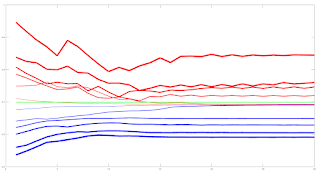
Due to the amount of training data available I decided to look only at a linear model and small neural networks (NN) with a single hidden layer with up to 6 hidden neurons. This choice was motivated by an academic paper I read online about linear models which stated that, as a lower bound, one should have at least 10 training examples for each parameter to be estimated. Other online reading about order flow imbalance (OFI) suggested there is a linear relationship between OFI and price movement. Use of limited size NNs would allow a small amount of non linearity in the relationship. For this investigation I used the Netlab toolbox and Octave. A plot of the learning curves of the classification models tested is shown below. The targets were binary 1/0 for price increases/decreases.

The blue lines show the average training error (y axis) and the red lines show the same average error metric on the held out cross validation data set for each tested model. The thickness of the lines represents the number of neurons in the single hidden layer of the NNs (the thicker the lines, the higher the number of hidden neurons). The horizontal green line shows the error of a generalized linear model (GLM) trained using iteratively reweighted least squares. It can be seen that NN models with 1 and 2 hidden neurons slightly outperform the GLM, with the 2 neuron model having the edge over the 1 neuron model. NN models with 3 or more hidden neurons over fit and underperform the GLM. The NN models were trained using Netlab's functions for Bayesian regularization over the parameters.

Looking at these results it would seem that a 2 neuron NN would be the best choice; however the error differences between the 1 and 2 neuron NNs and GLM are small enough to anticipate that the final classifications (with a basic greater/less than a 0.5 logistic threshold value for long/short) would perhaps be almost identical. 

Investigations into this will be the subject of my next post. 

The code box below gives the working Octave code for the above.

## load data
##training_data = dlmread( 'raw_netlab_training_features' ) ;
##cv_data = dlmread( 'raw_netlab_cv_features' ) ;
training_data = dlmread( 'netlab_training_features_svd' ) ;
cv_data = dlmread( 'netlab_cv_features_svd' ) ;
training_targets = dlmread( 'netlab_training_targets' ) ;
cv_targets = dlmread( 'netlab_cv_targets' ) ;

kk_loop_record = zeros( 30 , 7 ) ;

for kk = 1 : 30

## first train a glm model as a base comparison
input_dim = size( training_data , 2 ) ; ## Number of inputs.

net_lin = glm( input_dim , 1 , 'logistic' ) ; ## Create a generalized linear model structure.
options = foptions ; ## Sets default parameters for optimisation routines, for compatibility with MATLAB's foptions()
options(1) = 1 ; ## change default value
## OPTIONS(1) is set to 1 to display error values during training. If
## OPTIONS(1) is set to 0, then only warning messages are displayed. If
## OPTIONS(1) is -1, then nothing is displayed.
options(14) = 5 ; ## change default value
## OPTIONS(14) is the maximum number of iterations for the IRLS
## algorithm; default 100.
net_lin = glmtrain( net_lin , options , training_data , training_targets ) ;

## test on cv_data
glm_out = glmfwd( net_lin , cv_data ) ;
## cross-entrophy loss
glm_out_loss = -mean( cv_targets .* log( glm_out ) .+ ( 1 .- cv_targets ) .* log( 1 .- glm_out ) ) ;

kk_loop_record( kk , 7 ) = glm_out_loss ;

## now train an mlp
## Set up vector of options for the optimiser.
nouter = 30 ; ## Number of outer loops.
ninner = 2 ; ## Number of innter loops.
options = foptions ; ## Default options vector.
options( 1 ) = 1 ; ## This provides display of error values.
options( 2 ) = 1.0e-5 ; ## Absolute precision for weights.
options( 3 ) = 1.0e-5 ; ## Precision for objective function.
options( 14 ) = 100 ; ## Number of training cycles in inner loop.

training_learning_curve = zeros( nouter , 6 ) ;
cv_learning_curve = zeros( nouter , 6 ) ;

for jj = 1 : 6

## Set up network parameters.
nin = size( training_data , 2 ) ; ## Number of inputs.
nhidden = jj ; ## Number of hidden units.
nout = 1 ; ## Number of outputs.
alpha = 0.01 ; ## Initial prior hyperparameter.
aw1 = 0.01 ;
ab1 = 0.01 ;
aw2 = 0.01 ;
ab2 = 0.01 ;

## Create and initialize network weight vector.
prior = mlpprior(nin , nhidden , nout , aw1 , ab1 , aw2 , ab2 ) ;
net = mlp( nin , nhidden , nout , 'logistic' , prior ) ;

## Train using scaled conjugate gradients, re-estimating alpha and beta.
for ii = 1 : nouter
## train net
net = netopt( net , options , training_data , training_targets , 'scg' ) ;

train_out = mlpfwd( net , training_data ) ;
## get train error
## mse
##training_learning_curve( ii ) = mean( ( training_targets .- train_out ).^2 ) ;

## cross entropy loss
training_learning_curve( ii , jj ) = -mean( training_targets .* log( train_out ) .+ ( 1 .- training_targets ) .* log( 1 .- train_out ) ) ;

cv_out = mlpfwd( net , cv_data ) ;
## get cv error
## mse
##cv_learning_curve( ii ) = mean( ( cv_targets .- cv_out ).^2 ) ;

## cross entropy loss
cv_learning_curve( ii , jj ) = -mean( cv_targets .* log( cv_out ) .+ ( 1 .- cv_targets ) .* log( 1 .- cv_out ) ) ;

## now update hyperparameters based on evidence
[ net , gamma ] = evidence( net , training_data , training_targets , ninner ) ;

## fprintf( 1 , '\nRe-estimation cycle ##d:\n' , ii ) ;
## disp( [ ' alpha = ' , num2str( net.alpha' ) ] ) ;
## fprintf( 1 , ' gamma = %8.5f\n\n' , gamma ) ;
## disp(' ')
## disp('Press any key to continue.')
##pause;
endfor ## ii loop

endfor ## jj loop

kk_loop_record( kk , 1 : 6 ) = cv_learning_curve( end , : ) ;

endfor ## kk loop

plot( training_learning_curve(:,1) , 'b' , 'linewidth' , 1 , cv_learning_curve(:,1) , 'r' , 'linewidth' , 1 , ...
training_learning_curve(:,2) , 'b' , 'linewidth' , 2 , cv_learning_curve(:,2) , 'r' , 'linewidth' , 2 , ...
training_learning_curve(:,3) , 'b' , 'linewidth' , 3 , cv_learning_curve(:,3) , 'r' , 'linewidth' , 3 , ...
training_learning_curve(:,4) , 'b' , 'linewidth' , 4 , cv_learning_curve(:,4) , 'r' , 'linewidth' , 4 , ...
training_learning_curve(:,5) , 'b' , 'linewidth' , 5 , cv_learning_curve(:,5) , 'r' , 'linewidth' , 5 , ...
training_learning_curve(:,6) , 'b' , 'linewidth' , 6 , cv_learning_curve(:,6) , 'r' , 'linewidth' , 6 , ...
ones( size( training_learning_curve , 1 ) , 1 ).*glm_out_loss , 'g' , 'linewidth', 2 ) ;

## >> mean(kk_loop_record)
## ans =
##
## 0.6928 0.6927 0.7261 0.7509 0.7821 0.8112 0.6990

## >> std(kk_loop_record)
## ans =
##
## 8.5241e-06 7.2869e-06 1.2999e-02 1.5285e-02 2.5769e-02 2.6844e-02 2.2584e-16

Friday, March 25, 2022

OrderBook and PositionBook Features

OrderBook and PositionBook Features

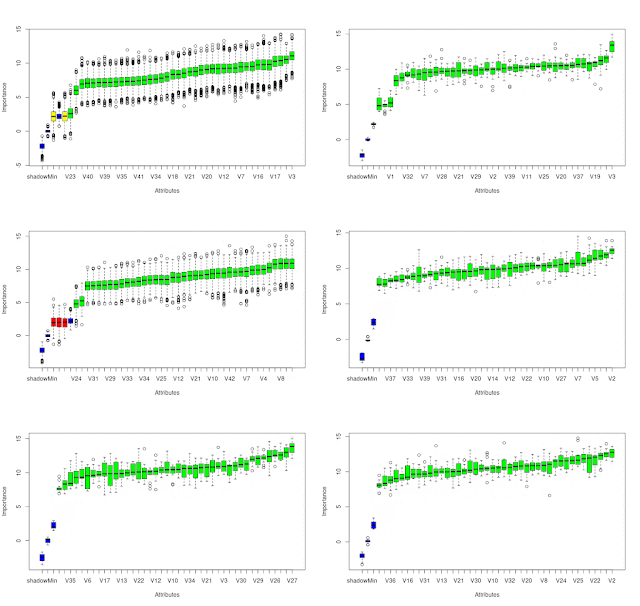
In my previous post I talked about how I planned to use constrained optimization to create features from Oanda's OrderBook and PositionBook data, which can be downloaded via their API. In addition to this I have also created a set of features based on the idea of Order Flow Imbalance (OFI), a nice exposition of which is given in this blog post along with a numerical example of how to calculate OFI. Of course Oanda's OrderBook/PositionBook data is not exactly the same as a conventional limit order book, but I thought they are similar enough to investigate using OFI on them. The result of these investigations is shown in the animated GIF below.

This shows the output from using the R Boruta package to check for the feature relevance of OFI levels to a depth of 20 of both the OrderBook and PositionBook to classify the sign of the log return of price over the periods detailed below following an OrderBook/PositionBook update (the granularity at which the OrderBook/PositionBook data can be updated is 20 minutes):

  • 20 minutes
  • 40 minutes
  • 60 minutes
  • the 20 minutes starting 20 minutes in the future
  • the 20 minutes starting 40 minutes in the future
for both the OrderBook and PositionBook, giving a total of 10 separate images/results in the above GIF.
 
Observant readers may notice that in the GIF there are 42 features being checked, but only an OFI depth of 20. The reason for this is that the data contain information about buys/sell orders and long/short positions both above and below the current price, so what I did was calculate OFI for:
  • buy orders above price vs sell orders below price
  • sell orders above price vs buy orders below price
  • long positions above price vs short positions below price
  • short positions above price vs long positions below price 
As can be seen, almost all features are deemed to be relevant with the exception of 3 OFI levels rejected (red candles) and 2 deemed tentative (yellow candles).

It is my intention to use these features in a machine learning model to classify the probability of future market direction over the time frames mentioned above. 

More in due course.

Tuesday, February 15, 2022

A Possible, New Positionbook Indicator?

A Possible, New Positionbook Indicator?

In my previous post I ended with saying that I would post about some sort of "sentiment indicator" if, and only if, I had something positive to say about my progress on this work. This post is the first on this subject.

The indicator I'm working on is based on the open position ratios data that is available via the Oanda api. For the uninitiated, this data gives the percentage of traders holding long and short positions, and at what price levels, in 14 selected forex pairs and also gold and silver. The data is updated every 20 minutes. I have long felt that there must be some value hidden in this data but the problem is how to extract it.

What I've done is take the percentage values from the (usually) hundreds of separate price levels and sum and normalise them over three defined ranges - levels above/below the high/low of each 20 minute period and the level(s) that span the price range of this period. This is done separately for long and short positions to give a total of 6 percentage figures that sum to 100%. Conceptually, this can be thought of as attaching to the open and close of a 20 minute OHLC bar the 6 percentage position values that were in force at the open and close respectively. The problem is to try and infer the actual, net changes in positions that have taken place over the time period this 20 minute bar was forming. In this way I am trying, if you like, to create a sort of  "skin in the game" indicator as opposed to an indicator derived from order book data, which could be said to be based on traders' current (changeable) intentions as expressed by their open orders and which are subject to shenanigans such as spoofing.

The methodology I've decided on to realise the above is constrained optimization using Octave's fmincon function. The objective function is simply:

    denom = X' * old_pb_net_pos ;

    J = mean( ( new_pb_net_pos .- ( ( X .* old_pb_net_pos ) ./ denom ) ).^2 ) ;

for a multiplicative position value change model where:

  • X is a vector of constants that are to be optimised
  • old_pb_net_pos is a vector of the 6 percentage values at the open
  • new_pb_net_pos is a vector of the 6 percentage values at the close

This is a constrained model because percentage position values at price levels outside the bar range cannot actually increase as a result of trades that take place within the bar range, so the X values for these levels are necessarily constrained to a maximum value of 1 (implying no real, absolute change at these levels). Similarly, all X values must be greater than zero (a zero value would imply a mass exit of all positions at this level, which never actually happens).

The net result of the above is an optimised X vector consisting of multiplicative constants that are multiplied with old_pb_net_pos to achieve new_pb_net_pos according to the logic exemplified in the above objective function. It is these optimised X values from which the underlying, real changes in positions will be inferred and features created. More on this in my next post.